
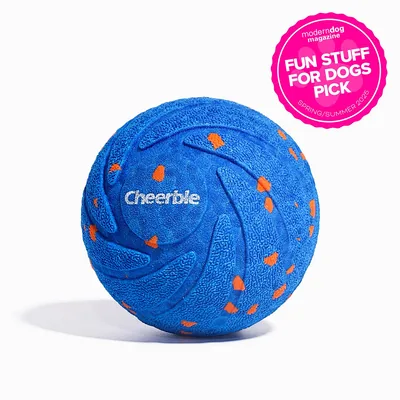
 Cheerble
Category
Interactive Toys
Self-driving balls, automatic ball launchers, and app-controlled toys that keep pets moving.
Cheerble YVE LIFE
YVE LIFE 4th Generation Motion Activated Automatic Cat Laser Toy
$19.98*Check Amazon for current price · as of Jul 20, 2026 MOHAYA
MOHAYA 4-in-1 Interactive Cat Toy
$29.98*Check Amazon for current price · as of Jul 20, 2026Compare interactive toys
Specs side by side
| Feature | Cheerble Wicked Ball AIR Interactive Dog Toy | YVE LIFE 4th Generation Motion Activated Automatic Cat Laser Toy | MOHAYA 4-in-1 Interactive Cat Toy |
|---|---|---|---|
| Brand | Cheerble | YVE LIFE | MOHAYA |
| Rating | ★ 4.1 | ★ 4.4 | ★ 4.1 |
| Price | $32.99*as of Jul 21, 2026 | $19.98*as of Jul 20, 2026 | $29.98*as of Jul 20, 2026 |
| Target | Cats and small dogs | Indoor cats and kittens | Indoor cats and kittens |
| Modes | 3 activity modes (gentle to active) | — | — |
| Battery | Rechargeable, ~8 hours per charge | — | — |
| Water Rating | IPX7 washable | — | — |
| Auto | Auto-obstacle avoidance and rest cycles | — | — |
| Distances | — | Motion sensor working distance up to 13.1 ft | Tabletop/floor play with track balls, feather, butterfly, and laser |
| Power | — | USB rechargeable 1200 mAh battery; about 2.5 hour charge time | USB rechargeable; Amazon page lists about 2 hour charge time |
| Ball Size | — | Not applicable; automatic laser toy | Built-in track balls; no launcher ball size |
| Safety | — | Low-power laser; indoor use with adjustable laser angle | No exposed power cord during play; low-power built-in laser |
| View on Amazon | View on Amazon | View on Amazon |
* Snapshot price from the date shown — check Amazon for the current price and availability.
Frequently asked questions
Are automatic pet toys safe to leave running unattended?
That depends on the toy and the pet. Many battery toys are built for short, self-directed sessions, but strings, small parts, and cords can turn into hazards for an enthusiastic chewer left alone. A sensible habit is to supervise the first several sessions, put the toy away afterward, and follow the maker's age and supervision guidance. Toys with an auto-shutoff timer are easier to leave running for a set stretch.
Which interactive toys work best for cats versus dogs?
Cats tend to respond to fast, erratic movement: laser patterns, motorized feathers, and wand-style teasers that mimic prey. Dogs usually want something durable they can chase, nudge, or work for a reward, like puzzle feeders and treat-dispensing balls. Matching the toy to how the animal actually plays matters more than the length of the feature list.
How do I choose the right toy for my pet's size and play style?
Start with size and intensity, since a toy built for a kitten can be flimsy for a large dog and a rugged chew toy can be too heavy for a small cat. Then match the play style: hunters want movement, chewers want durability, and food-motivated pets like puzzles. The specs we list, from materials to power source, are there to help you compare on those terms.
Related: How we compare
Are automatic laser toys safe for cats' eyes and behavior?
Keep the beam moving across floors and walls and never aim it at your cat's eyes or anyone else's; reputable laser toys are low-powered, but direct exposure is still a bad idea. Some cats also grow frustrated chasing a dot they can never catch, so it helps to end a session with a physical toy or treat they can actually win. If your cat seems anxious or fixated on the laser, switch to a toy with a catchable target.
How long do rechargeable interactive pet toys usually run?
Runtime ranges from under an hour to several hours of active play per charge, depending on the motor and battery. Many toys are built around short auto-play cycles rather than continuous motion, which stretches a charge across the day. Check the stated play time and whether the toy pauses itself between bursts.
Can interactive toys replace daily play with a person?
No; they are a supplement rather than a substitute. Automatic toys are useful for filling time and burning energy when you are busy, but pets still benefit from direct interaction and the bond it builds. Treat them as one part of a wider enrichment routine.